From Copy-Pasting ChatGPT to AI That Runs My Workflow
I used to paste code into ChatGPT like I was feeding a very slow, very forgetful colleague.
Copy the error. Paste it in. Explain what the project does. Get a suggestion. Try it. Get a new error. Paste that in too. Repeat until one of us gave up (usually me).
It worked, kind of. Every conversation started from zero though. No memory. No context. No idea what my project even was.
!The evolution from ChatGPT to multi-agent workflows
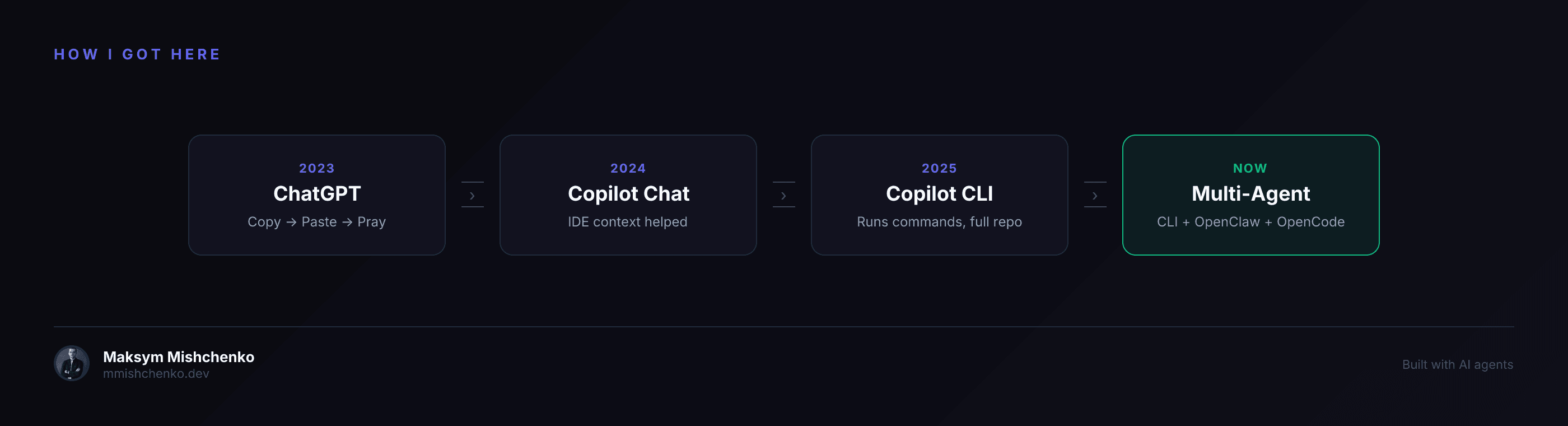
Copilot Chat was better, but still not it
When I switched to Copilot Chat in VS Code, things improved. It could see my files. I stopped copy-pasting entire classes just to ask a question.
But I was still the middleman. Run tests in terminal. Copy the output. Paste it into chat. Read the suggestion. Apply it manually. Five steps for every fix.
Better than ChatGPT? Sure. I was still the glue though.
Then I tried Copilot CLI
Copilot CLI was the shift. Instead of chatting about code, I started telling it to do things:
# actual command I ran last week
copilot "fix the failing tests in wardrobeApi"
It read the test output, found the wrong assertions, fixed them, re-ran. Passed. I didn't touch the keyboard.
That's when it stopped feeling like a tool and started feeling like a colleague. One that doesn't get distracted by Slack.
!Before vs After — how the workflow actually changed

What I actually use it for now
Here's my real workflow today:
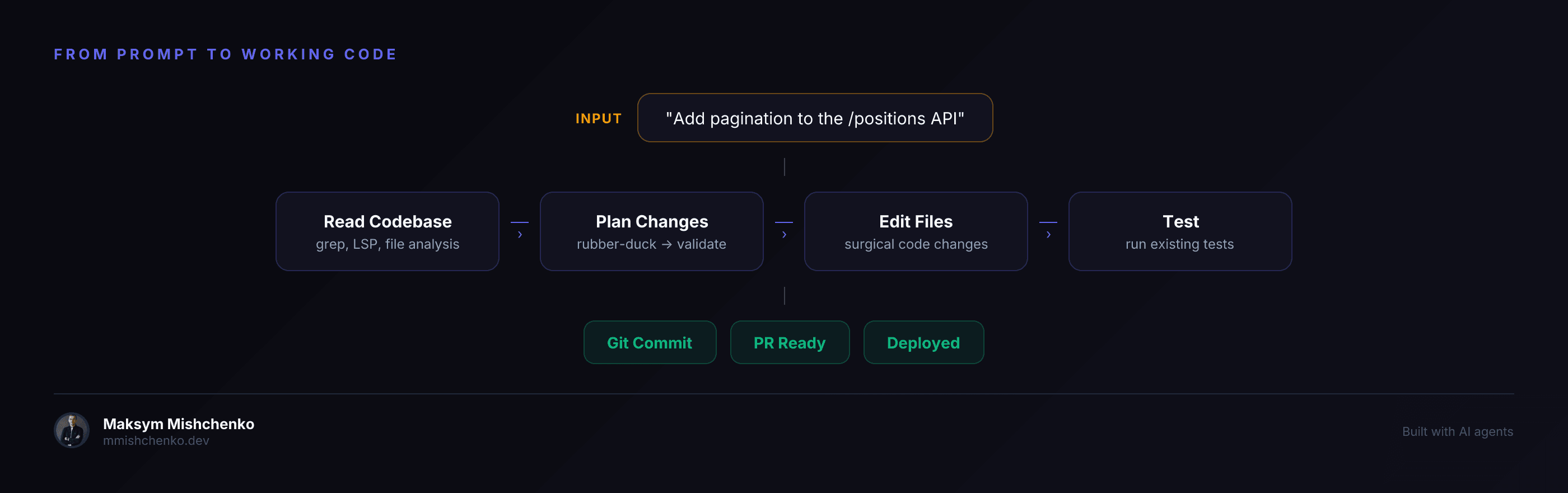
- "Add pagination to this endpoint" — it reads the controller, adds query params, updates the service, writes tests
- "Create a PR for these changes" — writes the commit message, pushes, opens the PR on GitHub
- "Refactor this service to use dependency injection" — plans the change, moves code, verifies nothing breaks
- "Scaffold a new API endpoint with tests" — creates the controller, service, DTO, and integration test in one shot
I stopped giving it instructions and started giving it ownership. Not "write a function that does X" but "own this feature, plan it, build it, test it."
!How a prompt becomes working code
It gets weirder: multiple agents
Right now I have three AI agents working together:
- Copilot CLI is the senior dev. Complex coding, PRs, architecture decisions.
- OpenClaw lives on my Azure VM. Routes tasks, runs cron jobs, talks to me through Telegram.
- OpenCode is the autonomous coder. I dispatch it from my phone and it just... builds things.
When I describe a feature in Telegram, OpenClaw breaks it into tasks and dispatches them. Copilot CLI reviews the output. I mostly just approve PRs at this point.
Is it perfect? No. Sometimes agents step on each other's work. Last week OpenCode and Copilot CLI both tried to edit the same file on the same branch. Had to manually resolve that. But even with the occasional mess, the friction is way lower than doing everything myself.
The moment it really clicked
Last week a colleague told me he'd been struggling to find a cheap frontend dev for his side project. Inventory management app — he had the backend done but couldn't find anyone to build the UI without burning weeks on back-and-forth.
I said — hold on. We recorded a 10-minute conversation describing what his UI should look like. Ran it through WhisperFlow and my agent setup. Got back a working React app: inventory management, session-prefilled database, payment stubs, clean layout. Ten minutes of talking. Zero Figma. Zero freelancer negotiations.
That's when it hit me — I'm not using AI to code faster. I'm covering the gaps I'm still yet to learn about. The frontend dev, the project manager scoping work, the designer mocking screens. Not because those roles aren't valuable. Because for a side project, the friction of coordination was the actual bottleneck — not the code itself.
What this means practically
You don't need a multi-agent system to start. But you do need to shift how you think about AI:
- Stop asking AI "what's wrong with this?" Start saying "fix this."
- Stop describing your codebase to it. Use tools that already see your files.
- Stop reviewing AI suggestions and applying them manually. Let it run commands, commit code, open PRs.
- Accept 90% quality on the first pass. You fix 10% instead of writing 100%.
The uncomfortable truth: the hard part of this transition isn't learning new tools. It's accepting that the way you've been working — carefully, manually, in full control — was the bottleneck all along.